






A field guide to when local AI is actually fast enough on your Mac
5 min read
People talk about AI speed as if the only question is who wins the benchmark.
That is not how writing feels.
In real work, the better question is simpler:
Was the tool fast enough to help before the sentence went cold?
That is the threshold that matters on a Mac.
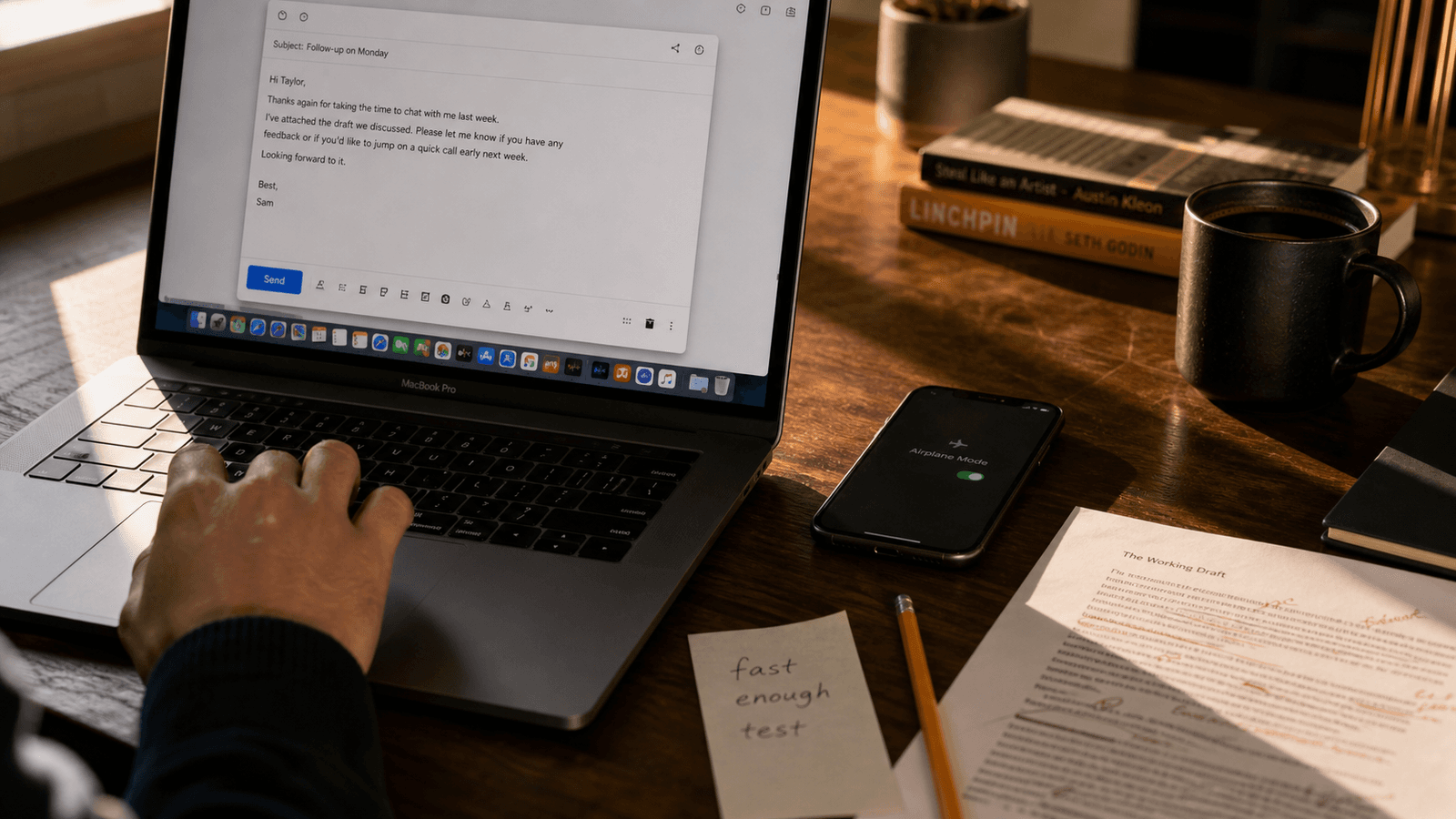
You are not usually waiting for AI to write a page. You are trying to keep a thought moving in Mail, Slack, Notes, Google Docs, or a comment box.
If help shows up inside that small pause, it feels fluid. If it misses that pause, the number on the benchmark chart does not save it.
This is the field guide.
1. Fast enough feels like you stay in the sentence
The first sign that local AI is fast enough is not that you notice the model.
It is that you barely notice the wait.
You start a sentence. You pause for a beat. A plausible continuation appears before your attention jumps somewhere else.
That matters because live writing has a rhythm. You think. You type. You hesitate. You choose. You keep going.
If the suggestion arrives inside that rhythm, it feels like assistance. If it arrives after you have already re-planned the sentence in your head, it feels late.
Late help is not neutral. It asks you to switch from writing to re-evaluating.
2. The most important latency test happens in short, ordinary writing
People often judge AI speed with a dramatic demo.
A blank page. A big prompt. A full paragraph appearing at once.
That can be impressive. It is not where most of the trust gets built.
Trust gets built in smaller moments:
the follow-up you are sending before the next meeting
the Slack reply you do not want to over-explain
the note above a document
the sentence that turns a rough thought into a clear ask
the comment that keeps a revision moving
These moments are short, but they happen all day.
That means small delays compound. Not because each one is huge. Because each one breaks the feeling that the tool belongs inside the work.
3. "Fast enough" is different from "fastest on paper"
This is where local AI gets misunderstood.
Some people hear "local" and immediately think in absolutes:
Is it faster than the cloud?
Is it slower than a bigger hosted model?
How many tokens per second does it produce?
Those questions are not useless. They are incomplete.
For writing, what matters most is whether the output is available at the point of need.
A tool can win a speed race in a lab and still feel clumsy in a real workflow if it asks you to:
open another surface
wait for context to load
explain what you are doing
read more than you needed
paste the result back
Meanwhile, a local tool can feel better even if it is not numerically dominant, because the help appears where you were already writing.
That is the difference between raw speed and usable speed.
4. The right test is whether you keep moving
Here is a practical way to judge performance without turning it into a hardware forum debate.
Ask yourself three questions during a normal workday:
1. When I hesitate mid-sentence, does the suggestion usually arrive before I give up on it? 2. When it appears, is it short enough to evaluate quickly? 3. Do I keep writing, or do I feel myself waiting on the tool?
If the answer to the third question is "I keep writing," you are close to the right zone.
That is the zone where autocomplete becomes part of flow instead of another dependency.
5. Some writing moments are more sensitive to delay than others
Not every writing task needs the same responsiveness.
A rough private note can tolerate more lag. A high-stakes reply usually cannot.
The moments where speed matters most tend to share a few traits:
the sentence is short
the stakes are social, not just informational
you already know what you mean
tone matters
you are moving between apps quickly
That is why "fast enough" often matters more in everyday professional writing than in long-form drafting.
The job is not invention from scratch. The job is keeping precision and momentum together.
6. Local AI earns trust when the speed is boring
The best-case feeling is strangely unglamorous.
Nothing dramatic happens. You do not stop to admire the model. You do not think about latency at all.
You just notice that more of your writing day stays intact.
The follow-up gets sent while the thread is still warm. The note lands before the idea fades. The comment sounds like you without becoming a bigger task than it needed to be.
That is what people actually want from performance.
Not spectacle. Not benchmark theater.
Just help that arrives early enough to preserve the thought.
Fast enough is a workflow threshold, not a bragging right
If you are evaluating AI writing help on a Mac, it helps to stop asking only, "How fast is this model?"
Ask:
Does it meet me inside the moment where I was already writing?
That is the threshold that separates a convincing demo from a useful tool.
For most professionals, the winner is not the system that looks most powerful from a distance.
It is the one that stays close enough to the sentence that work keeps moving.