Why writing on behalf of someone else needs AI autocomplete more than AI ghostwriting
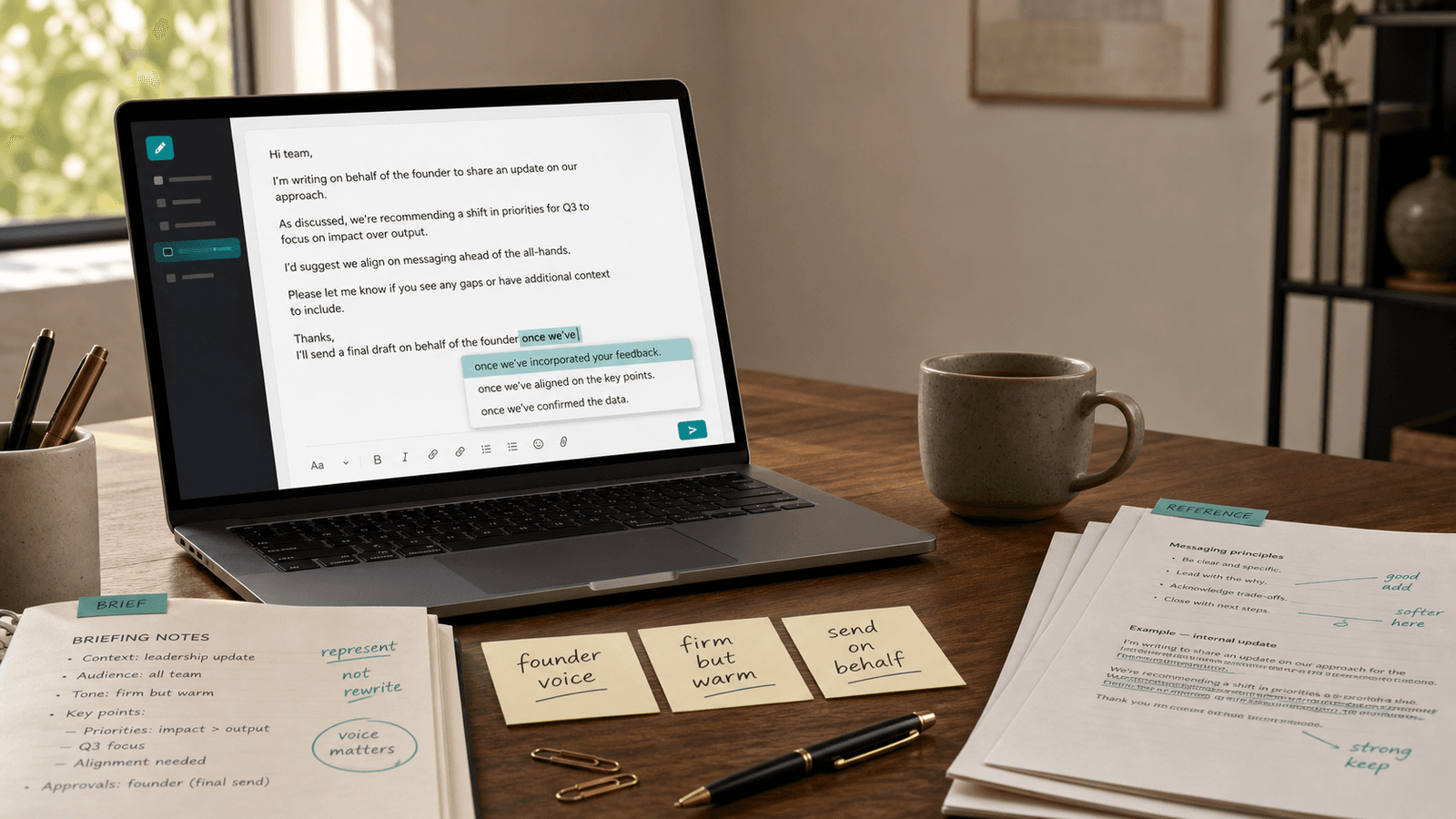
A lot of professional writing is not fully your own.
You are writing on behalf of a founder. Or a team. Or a brand. Or a customer relationship. Or a project that already has political context attached to it.
That changes what useful AI help looks like.
When the sentence is carrying someone else's judgment, tone, or trust, the goal is usually not to let a machine take the first real pass. The goal is to land the wording cleanly without losing the voice you are responsible for protecting.
That is one reason AI autocomplete often fits this kind of work better than AI ghostwriting.
Representational writing is a different job
Some writing is personal expression. Some writing is pure utility.
A large amount of work writing sits somewhere else.
It is representational.
You are not only trying to say something clearly. You are trying to say it in a way that another person, team, or company can stand behind.
That might be:
an executive assistant replying on behalf of a leader
a marketer writing in the company's public voice
a chief of staff summarizing a decision for the org
an agency lead replying to a client with the right mix of confidence and care
a product manager writing a note that reflects team alignment, not only personal opinion
The friction in these moments is rarely a lack of content.
It is calibration.
The voice matters because the sentence will be read as a proxy
When you write on behalf of someone else, the sentence is doing two jobs at once.
It carries information. It also stands in for presence.
The reader is not just hearing the words. They are hearing the executive, the company, the team, or the relationship behind them.
That is why small wording choices matter so much here:
how direct the message sounds
how much certainty it projects
whether the tone feels thoughtful or templated
whether the sentence sounds aligned with prior communication
whether the reader feels a human judgment behind it
This is exactly where a lot of AI writing tools start to feel risky.
Not because the output is always bad. Because the cost of subtle drift is high.
Ghostwriting tools can create a second voice you now have to manage
Generation-first AI often treats writing as a production problem.
Give the model the context. Ask for a draft. Review what comes back. Edit it until it sounds right.
That can help when the job is exploration.
It is often awkward when the job is representational writing.
Now the model has introduced a second voice into the process. Even if the draft is polished, you still have to inspect it for all the things that matter when you are speaking for someone else:
did it overstate the confidence?
did it sound too corporate?
did it smooth out a useful edge?
did it add warmth where firmness was needed?
did it make the message sound more generic than the person or brand actually is?
At that point, the work is no longer only writing. It is voice correction.
Most of the hard moments are small, fast, and scattered
Representational writing does not only happen in major announcements.
It happens in:
the follow-up after a meeting
the Slack clarification that resolves ambiguity
the customer note that resets an expectation
the internal update that needs to sound aligned before it gets forwarded
the browser field where the status explanation becomes permanent record
These are not ideal ghostwriting moments.
They are usually too contextual, too time-sensitive, and too voice-sensitive to justify opening another tool, briefing it, reading a draft, and editing it back into shape.
You already know what the message needs to do. You just need help finishing it without wobbling the voice.
This is where autocomplete has a structural advantage
Autocomplete helps later in the process and closer to the sentence.
You begin the message. You establish the tone. You set the direction. The AI helps with continuation, not authorship.
That is a better fit when the writer is accountable for preserving someone else's voice.
If the suggestion fits, you take it. If it drifts, you ignore it. If only part of it helps, you keep that part and move on.
The review surface stays smaller. The original intent stays closer. The human judgment remains visible in the writing because the human never left the sentence.
Good representational writing needs control more than volume
A lot of AI writing demos are built around how much text the tool can produce.
That is the wrong metric here.
When you are writing on behalf of someone else, usefulness is usually not about volume. It is about control.
Can you keep the tone consistent? Can you land the sentence without flattening personality? Can you move faster without making the message sound outsourced? Can you stay close enough to the wording that you would still sign your name, or someone else's, to it?
These are the questions that matter.
And they point toward lighter assistance, not heavier generation.
Across-app work makes the tradeoff even clearer
This kind of writing is almost never contained in one tool.
It moves across Mail, Slack, docs, notes, project tools, browser fields, and messages.
That matters because every separate AI workflow creates another opportunity for drift.
You stop. Re-explain the context. Read a draft. Translate it back into the right voice. Paste it into the real surface where the message belongs.
That process can be acceptable once. Repeated all day, it becomes expensive.
The better pattern is help that shows up where the writing is already happening.
Why this fits Typeahead
Typeahead is an AI autocomplete app for Mac that works across the apps where you already write.
It runs locally on your Mac. Suggestions appear inline while you type. You can accept the full suggestion, take it word by word, or ignore it completely.
That interaction model fits representational writing especially well.
It helps with the real job: protecting tone, keeping momentum, and getting to a cleaner sentence without handing the message over to a second author.
If you spend part of your day writing on behalf of a founder, a team, a brand, or a relationship, that trade matters.
The best AI help is often not ghostwriting. It is support that keeps the human responsible for the voice while making the sentence easier to finish.