Why the sentence that closes the loop needs better AI help
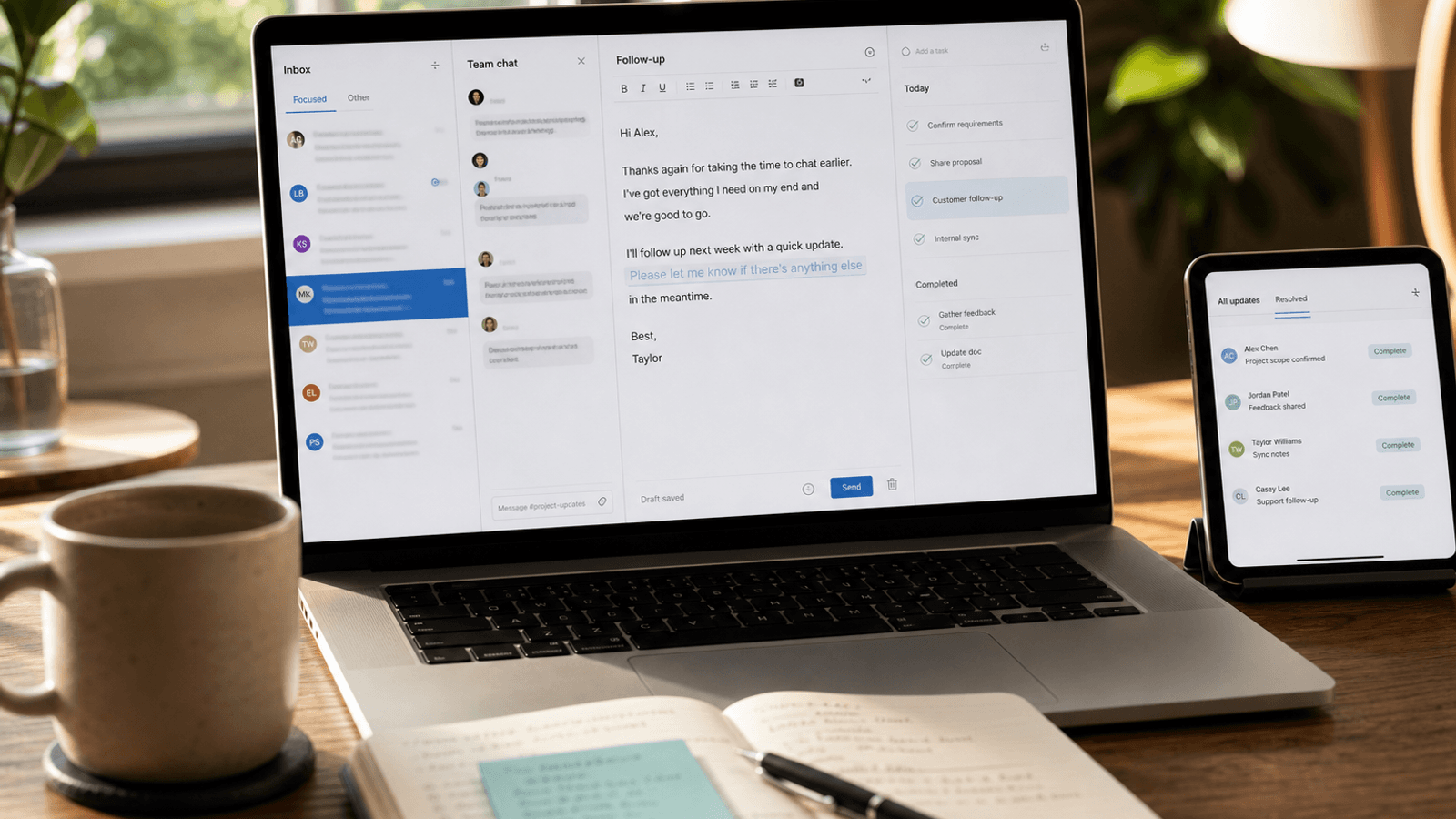
A lot of work stalls in one sentence.
Not the big strategy doc. Not the kickoff deck. Not the brainstorm.
The sentence that closes the loop.
The one that says:
here is the decision
here is the next step
here is what changed
here is what I need from you
here is the version we can move forward with
This kind of writing does not usually look dramatic. It still decides whether work keeps moving or starts circling.
That is one reason AI autocomplete can be more useful here than generation-first AI writing tools.
Loop-closing writing is where a lot of work actually happens
People often imagine writing as the production of large artifacts.
A proposal. A memo. A launch post. A board update.
Those things matter. But a surprising amount of real progress depends on much smaller writing moments:
the Slack reply that resolves ambiguity
the email follow-up that makes ownership explicit
the project note that turns discussion into action
the customer message that confirms the plan
the browser field that explains a change before someone asks for it again
These are loop-closing sentences.
They do not only communicate. They reduce drift. They narrow interpretation. They keep a conversation from reopening tomorrow.
That is why they carry more weight than their size suggests.
The hard part is usually not inventing language
Most of the time, by the point you are closing the loop, you already know the substance.
You know what happened. You know what the answer is. You know who needs to do what next.
The friction is in the final shaping:
how direct to sound
how much context to include
how firm the wording should be
how to make the next step obvious without sounding abrupt
how to land the sentence cleanly enough that nobody reopens the same thread
This is not a blank-page problem.
It is a precision problem.
That distinction matters because a lot of AI writing tools are built as if the main job is producing more words. Loop-closing writing usually needs better words, not more of them.
Full-draft AI can widen a job that should be getting smaller
Generation-first tools are often strongest when the task is open-ended.
They can help you explore. They can help you start. They can give you something to react to.
But loop-closing writing usually happens later. The context is already warm. The message is already half-formed. The goal is not exploration. The goal is resolution.
That is where a full draft can become awkward.
Instead of helping you finish one sentence, the tool may hand back a paragraph you now have to supervise:
did it add unnecessary softness?
did it make the decision sound less final?
did it introduce language nobody actually agreed on?
did it make the next step harder to see?
did it create a polished answer that still fails to close the loop?
The output may look competent. It can still make the workflow worse.
When the real task is compression, finality, and tone, extra generated surface area is often extra review work.
Closing the loop is a trust-sensitive form of writing
This is easy to miss because the messages are often short.
But short messages are where people often read the most into tone.
A loop-closing sentence can signal:
confidence or hesitation
ownership or ambiguity
alignment or drift
reassurance or avoidance
finality or another round of debate
That is why people often rewrite these messages more than they expect.
They are not trying to sound fancy. They are trying to make the sentence do its job the first time.
And that is exactly where many people get wary of AI writing tools. If the tool produces something that sounds generally fine but subtly wrong, the user ends up doing a second layer of repair before they can send it.
That feels like help in theory and extra work in practice.
Better AI help should arrive at the point of resolution
For loop-closing writing, the best help is often the lightest help.
Not a second workspace. Not a polished block of replacement copy. Not a mini drafting ritual for every small decision note.
Just enough assistance to finish the sentence while the judgment is still in the writer's hands.
That might mean:
landing the closing phrase of an email
tightening the sentence that names the next step
finishing the clarification before the thread gets longer
making the ownership line cleaner while the context is still fresh
This is where autocomplete has a structural advantage.
You start the sentence. You set the meaning. You establish the tone. The AI helps with continuation instead of taking first authorship.
If the suggestion helps, you take it. If it drifts, you ignore it. If only part of it works, you keep that part and move on.
That makes more sense for resolution writing than a tool that asks you to stop and review a larger block of text.
Across-app work makes this even more important
Loop-closing writing rarely lives in one place.
It moves across Slack, Mail, docs, project tools, notes, and browser fields.
That matters because every extra AI workflow creates more friction around the very moment that should feel decisive.
You leave the app. You restate the context. You review a draft. You paste something back. You trim it until it sounds like the message you were already trying to send.
That process may be acceptable once. Repeated all day, it becomes another source of drag.
The better model is help that meets the writer where the work is already happening. The sentence stays close to the live context. The decision stays attached to the real surface where it will be read. The writer keeps momentum instead of converting a small clarification into a larger production task.
The loop usually closes because the wording finally lands
A lot of work does not move because nobody typed enough. It moves because someone found the sentence that made the next step obvious.
That is a different standard for useful AI.
The question is not: "Can this tool generate a plausible message?"
The better question is: "Can this tool help me land the sentence that ends uncertainty?"
That points toward smaller, more controlled assistance. Help that respects the fact that the writer already knows the context, already owns the judgment, and usually only needs support in the last stretch.
Why this fits Typeahead
Typeahead is an AI autocomplete app for Mac that works across the apps where you already write.
It runs locally on your Mac. Suggestions appear inline while you type. You can accept the full suggestion, take it word by word, or ignore it completely.
That interaction model fits loop-closing writing especially well.
It helps where a lot of professional writing actually slows down: not at the beginning of the thought, but at the point where the sentence needs to become clear enough to move work forward.
The value is not that AI decides what the team should do. The value is that the right kind of AI can help the human responsible for the decision land the wording faster, with less drag, and without turning a small message into a bigger workflow.
For a lot of modern work, that is the real writing bottleneck.
Not starting. Closing the loop.