Why the sentence that changes direction needs better AI help
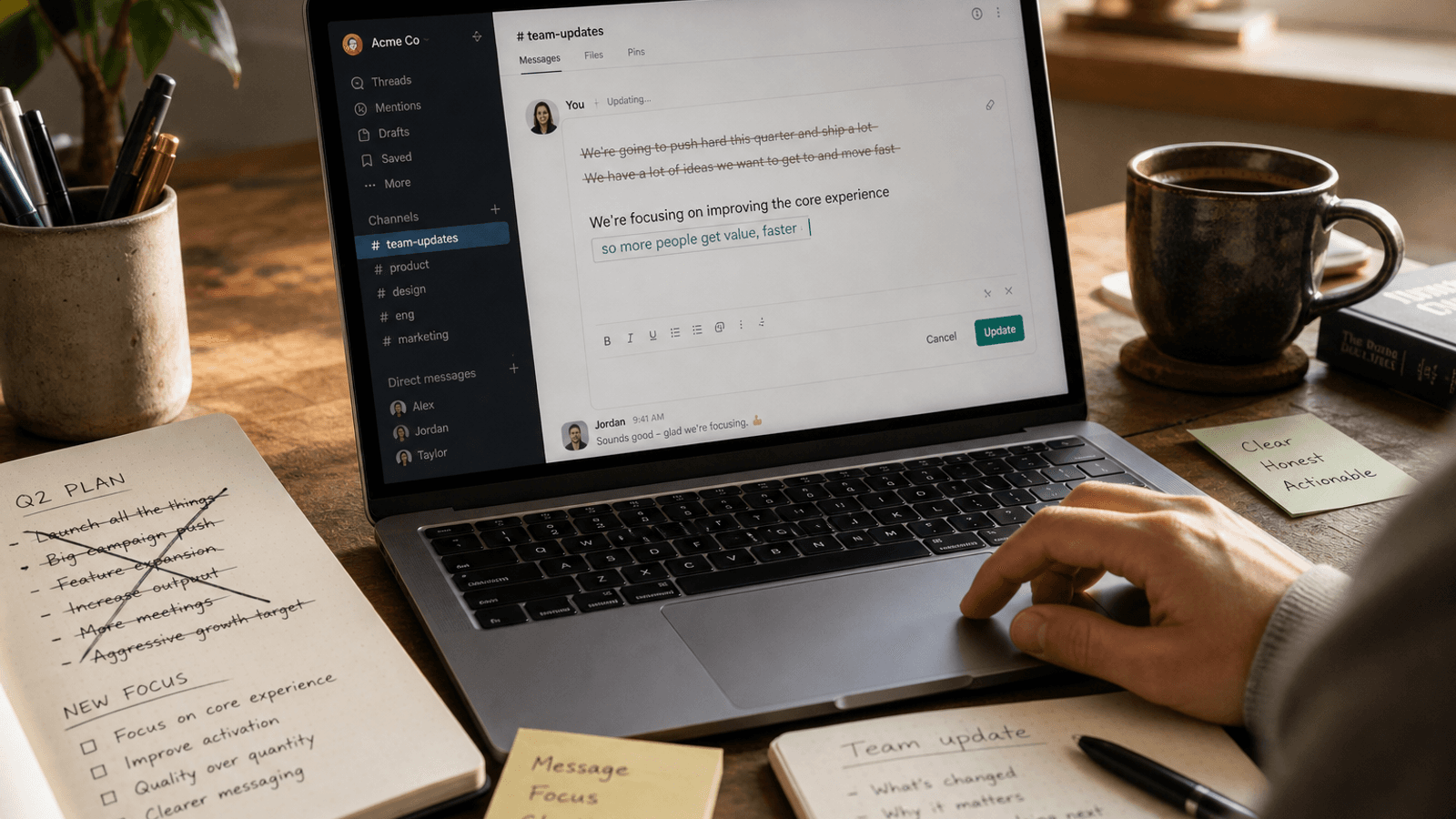
Some of the most important work writing does not start something.
It changes something that was already moving.
The sentence says:
- we are not doing it that way anymore
- here is the better route
- here is what changed
- here is what still holds
- here is how to move forward from here
These messages are common. They are also harder than they look.
That is one reason the right AI writing help here often looks more like autocomplete than full-draft generation.
Direction-changing writing carries more judgment than status writing
Routine updates are usually straightforward.
Direction changes are not.
The writer is often trying to do several things at once:
- acknowledge that the earlier path no longer makes sense
- make the change feel deliberate instead of chaotic
- preserve confidence without pretending nothing shifted
- explain the new constraint without opening five new debates
- help the next person act on the new reality quickly
That is not a blank-page problem.
It is a calibration problem.
A lot of work changes direction in small sentences
People often associate course changes with big announcements.
A strategy memo. A product reset. A major customer email.
Those matter. But a lot of real directional writing happens in much smaller places:
- the Slack reply that says the team is solving a different problem now
- the note in a doc that changes what "done" means
- the follow-up email that reframes the ask after new information came in
- the project comment that turns a soft assumption into a clear constraint
- the browser field that explains why the original plan is no longer the plan
These are not dramatic artifacts. They still shape how work moves.
One sentence can turn a team toward clarity or leave everyone half-following the old route.
The hard part is not finding words
Most people already know the substance of the change.
They know the timeline slipped. The customer priority moved. The assumption broke. The experiment taught the team something new. The simpler path turned out to be the better one.
What slows them down is landing the sentence cleanly enough that people understand both the change and the reason for it.
Should this sound firmer? Does this make the old plan sound wrong or simply outdated? Did this sentence explain the shift, or just announce it? Does the new direction feel real, or does it read like another temporary wobble? Did the wording protect confidence without hiding the turn?
That is sentence work.
Full-draft AI can smooth over the turn that people actually need to see
Generation-first AI often assumes the user wants a polished response.
Sometimes that is useful. It is risky when the point of the message is to redirect real motion.
Why?
Because direction-changing writing is sensitive to false smoothness.
A generated paragraph may:
- make the shift sound softer than it is
- bury the actual new direction inside polite explanation
- add strategic language nobody would say out loud
- sound more certain than the facts justify
- preserve the appearance of consistency while leaving people unclear on what to do differently
The output can read well and still fail at the job.
That is expensive when the sentence is supposed to move people off an old track and onto a new one.
The value is not polish
When a plan changes, people are not mainly looking for elegance.
They are looking for orientation. That same need for orientation shapes the sentence that gives teammates a starting point.
They want to know:
- what changed
- what did not change
- what matters now
- what happens next
That is why these messages get rewritten so often.
The best version does not only sound good. It reduces lag. It lowers reinterpretation. It stops half the team from continuing with yesterday's logic.
Better help should stay inside the writer's steering
For direction-changing writing, the useful question is not: "Can AI draft a plausible update?"
The better question is: "Can AI help me land the exact sentence that turns the team cleanly?"
That points toward lighter assistance.
The writer starts the message. The writer owns the shift. The writer decides how blunt, careful, or explanatory the turn needs to be. The AI helps continue the sentence without becoming the author of the change itself.
That is where autocomplete makes more sense.
If the suggestion sharpens the direction, take it. If it makes the shift sound vaguer, ignore it. If a few words help the turn land better, keep those and move on.
That is a better control surface than reviewing a whole generated block and trying to edit the real decision back into it.
Across-app work makes this more important
Direction changes rarely live in one formal artifact.
They move across Slack, email, docs, tickets, notes, comments, and browser forms.
That matters because the turn itself often happens in motion.
The project is already live. People are already working. The context is already hot.
If getting help requires leaving the app, re-explaining the situation, reading a larger draft, and pasting a cleaned-up version back, the change gets heavier exactly when it should get clearer.
Inline help fits better because it stays attached to the live sentence where the turn is actually being made.
Good direction-changing writing protects momentum
People often treat changed plans as a coordination problem.
They are also a wording problem.
Bad direction-changing writing creates:
- lingering attachment to the old plan
- confusion about what changed
- extra debate that should have been closed
- emotional over-reading of a practical shift
- hidden drift between teams
Good direction-changing writing does the opposite.
It makes the new route legible. It makes the reason feel real. It lets the team move without pretending the turn never happened.
That is one of the clearest tests for useful AI writing help.
If the tool cannot help with the sentence that changes direction, it is missing a large part of how real work actually gets unstuck.
Why this fits Typeahead
Typeahead is an AI autocomplete app for Mac that works across the apps where you already write.
It runs locally on your Mac. Suggestions appear inline while you type. You can accept the full suggestion, take it word by word, or ignore it completely.
That interaction model fits direction-changing writing especially well.
It helps at the point where the real work happens: inside the sentence that turns people toward a new course.
You keep authorship of the change. You keep control over the tone and the level of certainty. And the AI helps with momentum without quietly deciding how the shift should sound.
For a lot of modern work, that is the difference between writing help that merely sounds polished and writing help that actually helps a team turn.