Why PR teams need AI autocomplete more than AI press release generators
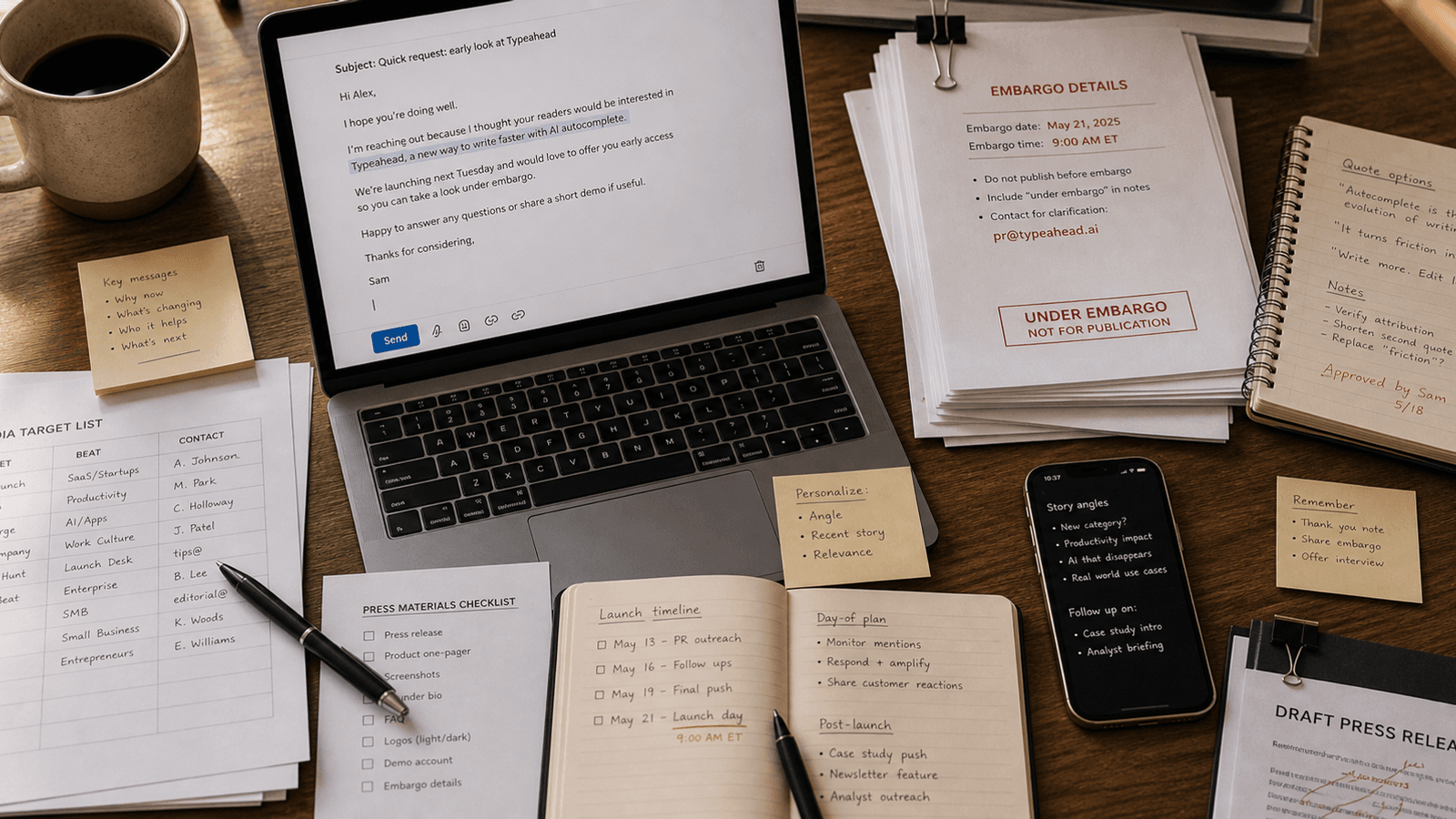
PR teams keep getting pitched AI for the most visible writing artifact.
Generate the press release. Draft the announcement. Write the launch email. Turn notes into a media brief.
Some of that is useful.
It is also not where a lot of communications work actually gets stuck.
The harder part is usually the smaller writing around the announcement.
The outreach email that needs to feel personal without becoming long. The follow-up that nudges without sounding desperate. The internal note that tells a founder what to say and what not to say. The Slack message that aligns marketing, product, and leadership on one exact framing. The fast response to a reporter question that needs to be precise before it can be polished.
That is why PR teams often need AI autocomplete more than AI press release generators.
Communications work runs on sentence judgment
People outside PR often picture the big artifact.
The launch post. The media announcement. The formal statement.
Those matter.
But the day-to-day work is full of shorter, more delicate writing:
media pitches
follow-up emails
briefing notes
founder prep
reactive statements
internal approvals
Slack alignment
talking points
customer-facing clarifications
last-minute message edits
Most of these are not blank-page problems.
The communicator usually already knows the story. The friction is landing the sentence with the right balance of clarity, restraint, and tone.
That is a different job from asking a model to generate a polished block of copy from scratch.
The risk in PR is rarely not having words
PR teams do not usually struggle because they have nothing to say.
They struggle because the wording has consequences.
One sentence can make a launch sound inflated. One adjective can make a company sound defensive. One awkward follow-up can make a pitch feel mass-sent. One over-polished reply can flatten the human judgment that the moment actually needs.
That is why a lot of full-message AI writing feels wrong for communications work.
It often creates language that is smooth before it is accurate. It offers something that sounds finished before the team has decided what it really wants to signal.
In PR, that order matters.
Press release generators solve the least frequent part of the job
A press release is visible. It is important. It is also only one part of the work.
Most communications effort happens before and after the formal asset exists.
Before:
shaping the positioning
tightening the founder quote
aligning teams on language
drafting the first outreach note
After:
replying to journalists
adjusting angles for different outlets
clarifying details internally
following up without sounding robotic
turning the announcement into dozens of smaller messages across apps
That is where the daily writing load lives.
A generator that helps with the headline artifact can still miss the writing that actually consumes the week.
The real PR day lives across apps
Communications work is scattered by design.
You move between email, Slack, docs, comments, browser forms, planning notes, and calendar descriptions. You are rarely sitting in one dedicated writing surface long enough for a separate AI workflow to feel natural.
That is why chat-style writing help often adds friction instead of removing it.
Open another window. Restate the context. Read three options. Paste one back. Edit it until it sounds like the company and the moment.
That can be worth it for a big draft. It is a clumsy trade for the fifteenth sentence of the day that still needs care.
Autocomplete fits better because the help appears where the work already is.
The pitch sentence. The follow-up. The internal note. The response to a reporter.
The writing keeps moving without asking the communicator to leave the flow of the work.
PR needs control more than polish
This is the part AI demos usually miss.
Communications teams are not just trying to sound good. They are trying to stay intentional.
How direct should this be? How much should we acknowledge? Should this feel warm, neutral, or firm? Is this sentence helping the story or overstating it?
Those are judgment calls.
That is why inline AI autocomplete is a better fit than generation-first tools for a lot of communications work.
It keeps the communicator in control of the message. You start the sentence. You decide the direction. The suggestion helps if it fits. If it does not, you ignore it and keep writing.
That interaction model matters because it preserves authorship. It speeds up the expression without taking over the intent.
Good PR writing often looks effortless because the hard part stayed invisible
The best communications writing rarely calls attention to itself.
It sounds clear. Measured. Timely.
It feels obvious after the fact.
What people do not see is how many sentence-level decisions created that result.
The line that kept a launch note from sounding exaggerated. The edit that made a media pitch feel specific instead of templated. The follow-up that got a reply because it sounded human. The internal message that prevented three teams from telling three different versions of the same story.
That is where useful AI writing help should show up.
Not as a machine that tries to do PR on your behalf. As a quieter layer that helps you move faster through the writing you were already going to own.
The better AI model for PR is assistance inside the sentence
For communications teams, the ideal writing tool should feel lightweight.
Not a second author. Not a separate workflow. Not a press release machine that assumes the formal asset is the entire job.
Something closer to predictive text, but smarter. Something that helps with momentum while preserving taste. Something that works across apps because the work itself is across apps.
That is the practical advantage of AI autocomplete.
It supports the actual writing load of PR:
the outreach
the reactive note
the careful clarification
the internal alignment
the sentence that has to land correctly the first time
That is a better fit for how communications teams really work than another generator focused on the biggest document in the room.
If you want AI writing help that fits the real shape of PR work, try Typeahead. It works across the apps where communications teams already write on their Mac, stays inside the sentence, and helps you move faster without giving up control of the message.