Why HR teams need AI autocomplete more than AI policy generators
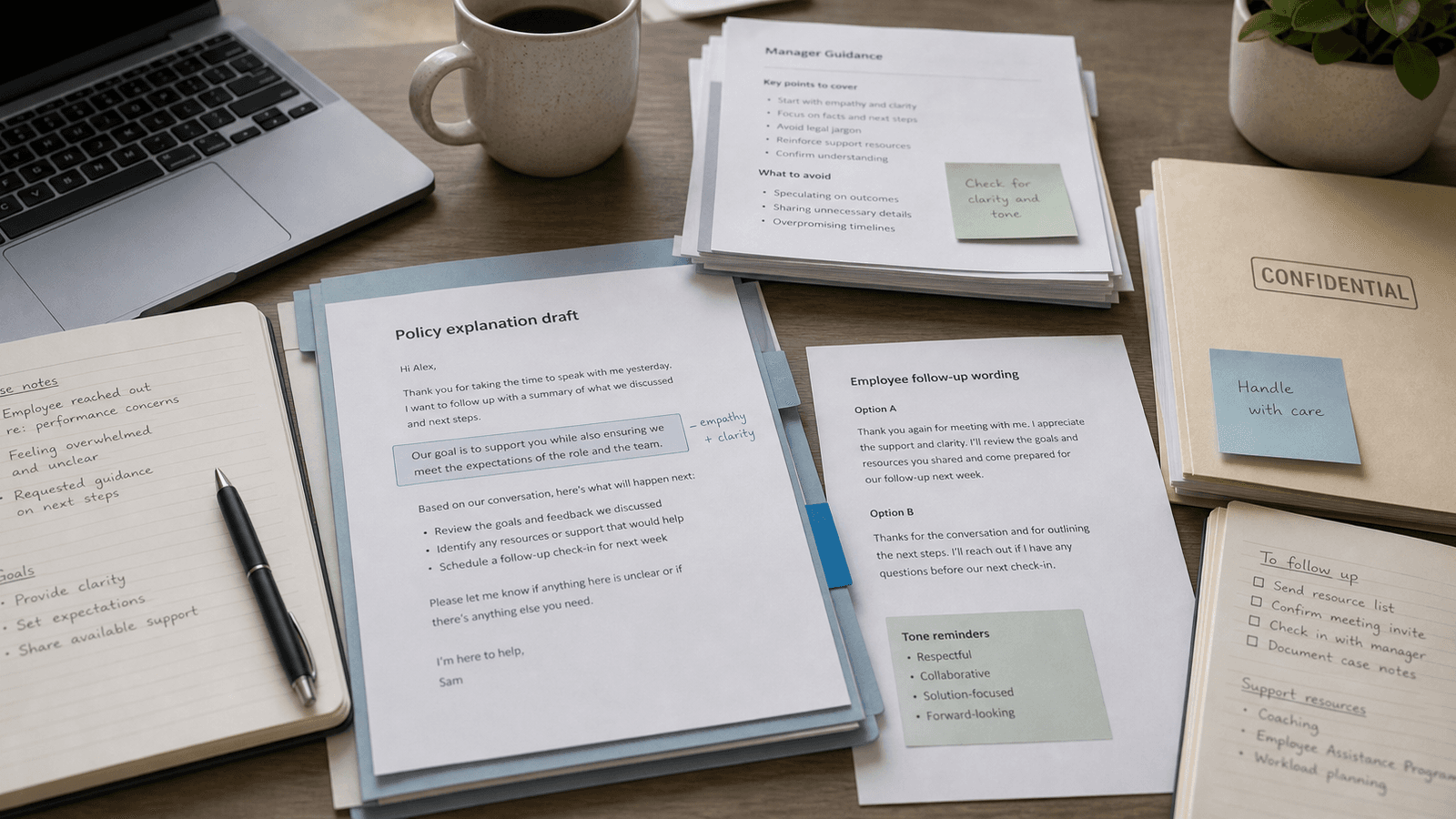
HR teams keep getting pitched AI at the formal-document layer.
Generate the policy. Rewrite the handbook. Draft the job description. Summarize the employee feedback.
Some of that is useful.
It is also not where a lot of people-ops writing friction actually lives.
The harder work is often in the smaller, more sensitive writing around the formal artifact.
The Slack message that needs to be clear without sounding cold. The follow-up after a difficult conversation. The note that turns a manager's vague concern into something specific and fair. The email that explains a policy change without making it feel threatening. The internal comment that needs precision because other people will act on it.
That is why HR teams often need AI autocomplete more than another AI policy generator.
The real HR writing load is not only in policies
From the outside, HR writing can look like a set of large documents.
Handbooks. Policies. Offer letters. Performance frameworks. Training materials.
Those matter.
But the day-to-day writing load is much more scattered than that.
It shows up in:
Slack follow-ups with managers
interview coordination
recruiting notes
candidate communication
internal documentation
benefits explanations
employee-relations notes
meeting recaps
process clarifications
approval requests
This writing is constant. It is usually short. It is often time-sensitive. And it regularly carries more relational weight than the larger documents do.
The hardest part is judgment, not generation
Most HR professionals do not get stuck because they have no words.
They get stuck because the wording matters.
How direct should this be? How much context should this include? Should this sound firmer or more supportive? Is this sentence clear enough to guide a manager without sounding accusatory? Does this note preserve the nuance someone may need later?
Those are judgment problems.
A policy generator is built for producing a formal asset. It is much less helpful when the job is shaping a sentence that needs tact, clarity, and accountability at the same time.
That kind of writing usually does not need a machine to invent the message. It needs help finishing the message without flattening the human judgment inside it.
HR writing is full of high-stakes small moments
People often underestimate how much of HR work happens in small text boxes.
A private message to a manager. A candidate follow-up. A note after a sensitive call. A quick explanation inside an internal tool. A comment on a process doc.
None of these look like headline writing tasks. They still influence trust, consistency, and how fairly situations get handled.
One sentence can make a message feel calm or defensive. Specific or vague. Helpful or overly legalistic.
That is why people-ops teams often care less about big AI output and more about whether a tool helps them land the sentence cleanly.
Why policy generators only solve the visible part
Formal policy work is visible, so it is easy to build AI around.
You can demo a generated leave policy. You can show a rewritten handbook section. You can automate the first pass of a job description.
That is real value.
It is also only one slice of the writing job.
Most HR teams spend more time translating policy into day-to-day communication than creating policy from scratch.
They have to explain what changed. Clarify what applies in a specific case. Answer the follow-up question. Turn a principle into usable language for a real person in a real situation.
That is where the writing gets delicate.
And delicate writing usually benefits more from sentence-level help than from full-message generation.
The work happens across apps, not inside one HR system
People-ops writing is unusually distributed.
You move between email, Slack, docs, ATS notes, calendar invites, browser forms, internal tools, and comments on shared documents.
That matters because workflow shape matters.
If the AI help only works in one surface, it misses a lot of the day. If it requires a separate chat session every time you need help, it adds ceremony to the exact kind of writing that needs less ceremony.
Autocomplete is a better fit because it follows the writing itself.
The candidate email. The process note. The manager follow-up. The internal clarification.
Instead of building a second writing workflow, it supports the one already happening.
Control matters more in HR than most AI demos admit
HR writing should not feel outsourced.
That is true for legal reasons sometimes, but it is also true for human reasons.
These messages often require tone, restraint, and context that do not belong to a generic generator.
People want help that keeps them in charge. They want to accept a useful phrase, keep their own framing, and move on.
That interaction model matters because the cost of sounding slightly off is high in people work.
The sentence may be short. The consequence may not be.
Better AI writing help for HR should feel quieter
For a lot of HR teams, the best AI help is not the kind that produces the most dramatic demo.
It is the kind that makes ordinary writing lighter:
a cleaner manager note
a faster candidate follow-up
a clearer benefits explanation
a more balanced internal update
a sharper sentence in a process doc
That kind of help compounds because it shows up in the real writing day, not only in the formal document moments.
That is why AI autocomplete is such an interesting fit for people-ops work. It helps with the careful writing between the policies, where clarity and tone carry most of the load.
If you want AI writing help that fits the actual shape of HR work, try Typeahead. It works across the apps where HR teams already write on their Mac, runs locally, and helps the sentence move faster without taking the judgment away from the person writing it.