Why board update writing fits AI autocomplete better than AI deck generators
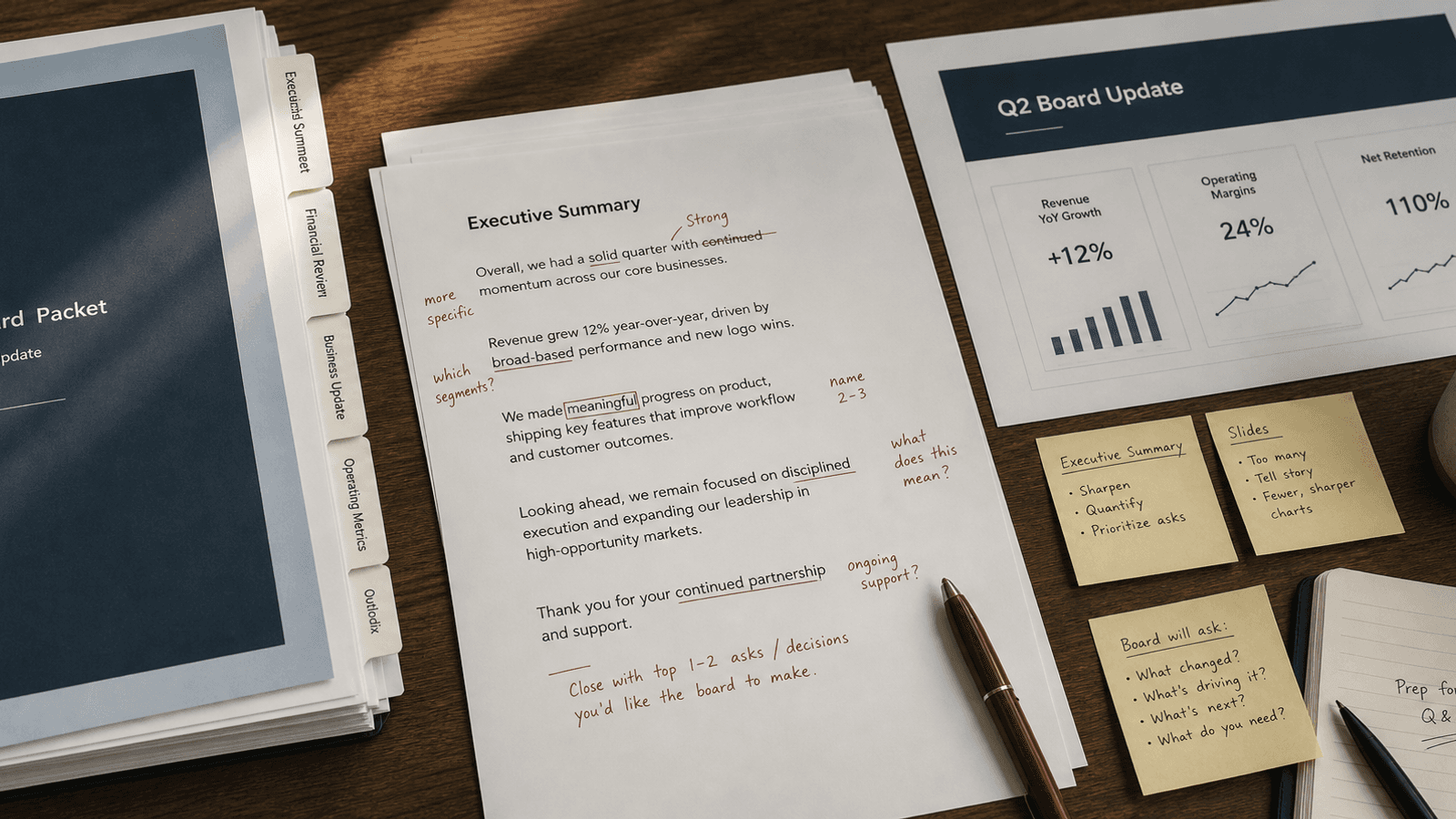
Board updates are rarely hard because nobody knows what happened.
They are hard because someone has to explain what happened clearly enough that the room trusts the explanation.
The numbers have to be right. The tone has to be steady. The weak spots cannot be hidden. The confidence cannot feel inflated. The next steps have to sound deliberate, not defensive.
That is why board update writing often fits AI autocomplete better than AI deck generators.
The hard part is usually not making slides
When people think about board prep, they usually picture:
- metrics
- charts
- deck design
- financial models
- meeting prep
All of that matters.
But a lot of the real difficulty shows up in the writing around the board update:
- the summary at the top of the deck
- the note that explains why one number moved
- the sentence that acknowledges a miss without sounding evasive
- the follow-up email after the meeting
- the internal message that turns feedback into a plan
That writing is what gives the board something to trust.
Board-update writing is rarely a blank-page problem
Most founders, finance leads, and chiefs of staff already know the story they need to tell.
Revenue came in ahead or behind. Pipeline quality changed. Hiring slowed down. Retention improved. A product bet is working, or it is not.
The friction is not inventing a story from nothing. It is choosing the wording carefully enough that the story stays honest and lands cleanly.
Should this sound more direct? Does this sentence understate the risk? Does this paragraph sound too polished for a hard quarter? Is this concise enough for the board memo but still specific enough to be useful? Does this recommendation sound committed, or just optimistic?
That is a sentence-level problem.
A lot of trust is won or lost in small lines
Board communication has a strange property.
One vague sentence can make the team sound less self-aware than it is. One overconfident line can make a plan sound less credible. One defensive paragraph can turn a manageable miss into a trust problem.
That is why board writing deserves more respect than it usually gets.
The board does not just evaluate results. It evaluates judgment. Judgment shows up in how the company explains reality.
That explanation usually lives in a handful of careful sentences.
Why deck-generation AI misses the harder part
A lot of AI for board prep focuses on the visible artifact.
Generate the deck. Summarize the KPI changes. Turn notes into slides. Draft the board memo.
Some of that can help.
But board work is usually not slowed down by a lack of slide production. It is slowed down by the wording choices around the facts:
- how to frame the quarter without spin
- how to explain a miss without rambling
- how to make a recovery plan sound real
- how to describe uncertainty without sounding lost
- how to write a follow-up that keeps the team aligned after the meeting
That is a different job from generating a presentation shell.
The hard part is not making more language. It is making better language inside a high-accountability moment.
The workflow lives across apps, not inside one board tool
Board prep does not happen in one place.
It moves through spreadsheets, slides, docs, email, Slack, notes, browser tabs, and comments all day.
That matters because the writing load is fragmented:
- a line in the deck
- a comment under a chart
- a reply to an investor question
- a Slack note to the leadership team
- an email that tightens the takeaway after the call
If the AI help only lives in a separate generation window, the workflow gets heavier:
- open another tool
- explain the context again
- paste the draft
- review a larger rewrite
- trim it back down
- paste it into the place where the sentence actually belongs
That is clumsy when the real work is dozens of careful edits across the day.
Autocomplete fits better because the help appears where the writing is already happening. You can see that fit over a real writing day across Mac apps, where trust is built one accepted completion at a time.
Control matters more when the audience is the board
Board communication is not a place where people want a machine to take over the voice.
The person writing needs to stay responsible for:
- what is being claimed
- what is being softened
- what is being admitted
- what is being asked for
That is why generation-first AI can feel risky here.
It may produce something polished before the underlying judgment is fully expressed. Now the team has to inspect the output for spin, overstatement, vagueness, or a tone that does not feel like them.
Autocomplete is narrower. That is exactly why it can be more useful.
You keep the judgment. You keep the ownership. You accept what helps and ignore what does not.
For high-stakes writing, that can feel much safer than supervising a full AI rewrite.
Better AI help for board prep should feel quiet
The most useful AI for board updates is not the flashy demo that makes slides appear.
It is the quiet help that improves the real communication layer:
- a cleaner opening summary
- a sharper explanation under a chart
- a calmer sentence about risk
- a more direct next-step note
- a better follow-up after the meeting
That kind of help compounds because board communication shapes how a company sees itself. It shapes what gets attention. It shapes what earns trust.
That is why board update writing often fits AI autocomplete better than AI deck generators.
If you want AI writing help that fits the real shape of board prep, try Typeahead. It works across the apps where the writing already happens on your Mac, runs locally, and helps you finish the sentence without taking over the judgment behind it.