Why approval-heavy writing fits AI autocomplete better than AI first drafts
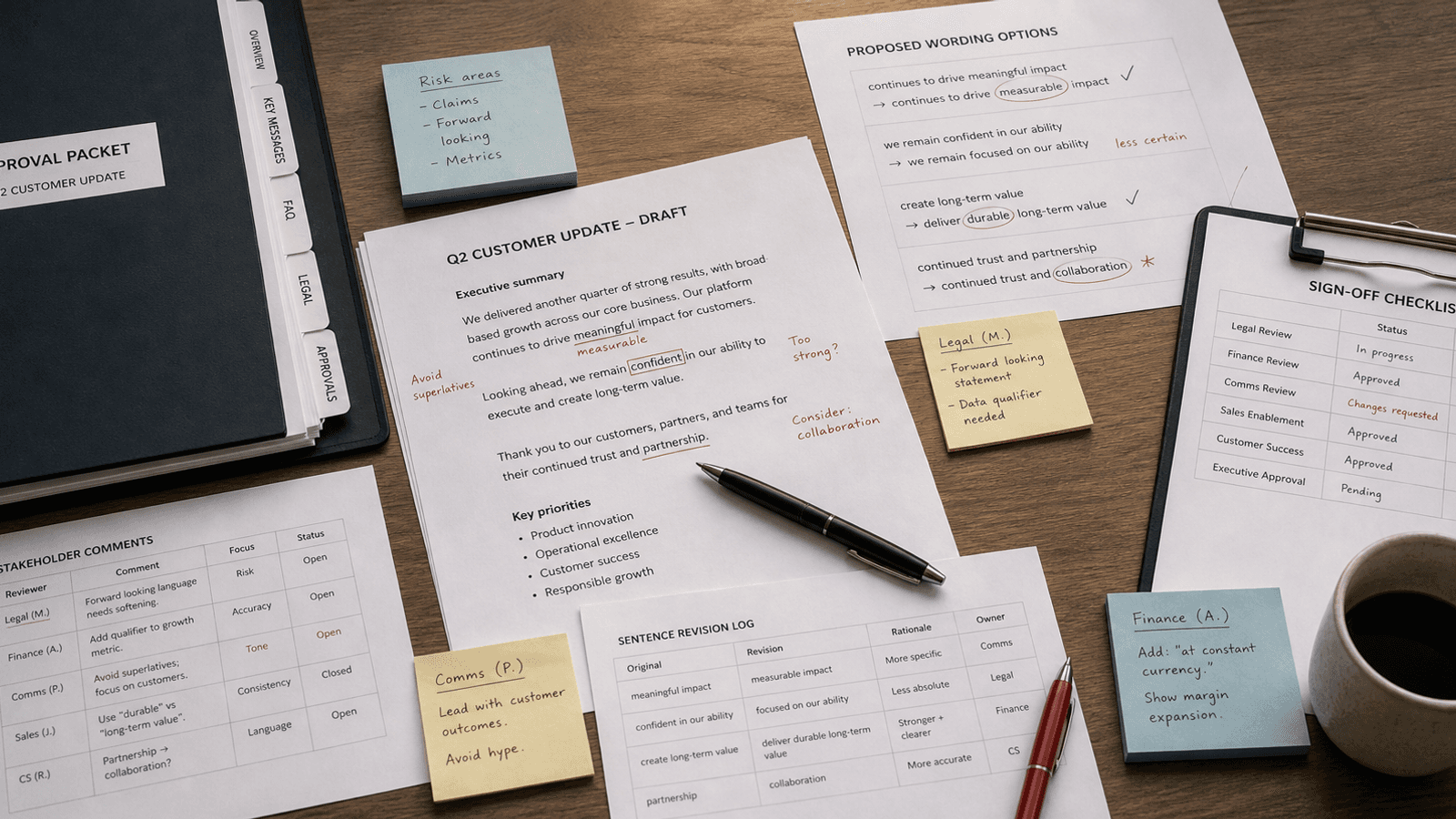
Some writing is not hard because the blank page is intimidating.
It is hard because someone else has to approve the sentence.
The client note that needs a sign-off. The founder update that has to be exact before it goes out. The product launch message that three teams will read differently. The policy change that needs legal, people, and leadership aligned. The reply in a shared Slack channel where one loose phrase creates an avoidable thread.
This is approval-heavy writing.
And it has a different shape than most AI writing demos assume.
The problem is usually not generating a first draft from nothing. The problem is landing the sentence cleanly enough that other people can say yes to it quickly.
That is one reason AI autocomplete often fits approval-heavy work better than AI first-draft tools do.
The friction is rarely the first version
When people imagine AI writing help, they often imagine a tool producing the draft.
Write the email. Draft the announcement. Generate the policy note. Turn the meeting into a recap.
That can be useful.
But approval-heavy work usually slows down later in the process.
The first version exists. Now it needs to become:
- clearer without becoming colder
- shorter without losing the nuance
- more confident without overcommitting
- more careful without sounding defensive
That is not a blank-page problem. It is a sentence-shaping problem.
Most people doing approval-heavy writing already know the point they are trying to make. What takes time is phrasing it so the right people can approve it without opening three new debates.
Approval work is really wording-risk management
The more stakeholders a sentence has, the more each word starts carrying extra weight.
This is true in places like:
- launch copy
- customer communication
- internal policy updates
- executive notes
- PR statements
- legal-adjacent writing
- partnership emails
- change-management messages
In all of those cases, people are not only asking, "Does this sound good?"
They are asking:
- Is this precise enough?
- Does it imply too much?
- Does it create the wrong expectation?
- Does it sound like us?
- Is there any phrase here that will trigger unnecessary back-and-forth?
That is why approval-heavy writing often moves slowly.
The sentence is doing more than carrying information. It is carrying risk, tone, accountability, and coordination at the same time.
Why first-draft AI can create more review work
First-draft AI is built to be helpful by being substantial.
It gives you a full paragraph. Sometimes a full page. Often a version that looks polished enough to tempt people into using it.
That polish can be useful. It can also create a hidden problem.
The more complete the draft looks, the more review work it can create.
Now the team is not just checking the meaning. They are checking a machine's phrasing choices line by line.
Why did it frame it that way? Does that adjective overstate the claim? Does this sentence sound too formal? Does this imply legal review already happened? Does this read like marketing instead of operations?
Instead of speeding up approval, the generated draft can widen the review surface.
There is simply more language to inspect, more tone to normalize, and more machine-authored phrasing to edit back into something the team actually stands behind.
The better fit is help that stays close to the intended sentence
This is where autocomplete has a different advantage.
It does not try to win by producing a whole new message for the group to react to. It helps the writer finish the sentence they were already steering.
That matters because approval-heavy writing usually works best when the original intent stays stable.
The writer already knows:
- what can and cannot be said yet
- which phrasing will make legal nervous
- what the founder will object to
- what the customer actually needs to hear
- where the tone needs to be warmer or firmer
Inline help supports that judgment instead of competing with it.
You keep typing. You accept what fits. You ignore what does not. The message stays anchored to the human who is accountable for it.
That tends to produce something easier to approve because it starts closer to the real intent.
Approval-heavy writing happens across apps, not inside one drafting session
Another reason this matters: approval work is rarely contained in one document.
A sentence starts in Notes. Gets pasted into Slack. Moves into an email. Ends up in a doc comment. Comes back as a revised line in a launch brief. Then gets shortened again for the final send.
That scattered workflow is normal.
It is also where a lot of AI writing tools become awkward.
If help only exists in a separate chat window, every revision round creates more ceremony:
- open the tool
- restate the context
- paste the latest version
- ask for another rewrite
- review the new tone
- paste it back
That is clumsy when the real job is tightening one sentence across five apps while three people are waiting.
Autocomplete fits better because it follows the writing itself. The approval note. The Slack edit. The final email line. The browser field for the announcement form.
The help appears where the work already is.
Control matters more when the message represents more than one person
A lot of approval-heavy writing is not fully personal writing.
You are writing on behalf of a team, a company, a project, or a decision.
That changes the standard.
The goal is not only speed. The goal is controlled speed.
You want the sentence to move faster without becoming less trustworthy. You want help without creating a second invisible author whose judgment now has to be reviewed too.
This is one reason so many people feel uneasy with full-message AI in high-stakes communication.
Even when the output is decent, it can feel slightly unowned. Like the team is approving language that is plausible, but not fully theirs.
Autocomplete is narrower. That is exactly why it can feel safer.
It keeps authorship local. The writer still makes the real call. The AI helps with momentum, not message ownership. For client drafts, local AI for legal writing keeps the words you type and the completions you accept on the device.
Better approval workflows need less generation and more precision
Approval-heavy writing does not usually need bigger outputs. It needs fewer avoidable revisions.
The most useful AI help is often:
- one cleaner continuation
- one sharper phrase
- one calmer way to say the same thing
- one faster route to the version people can approve
That kind of help compounds because these moments happen all day.
A customer reply. An internal update. A leadership note. A launch sentence. A change announcement.
None of them are giant writing projects. Many of them still carry consequences.
That is why approval-heavy work is such a strong fit for inline AI autocomplete.
This is where Typeahead makes sense
Typeahead is an AI autocomplete app for Mac that works across the apps where you already write.
It runs locally, appears inline while you type, and helps you move the sentence forward without pulling you into a separate drafting workflow.
That is especially useful for approval-heavy writing, where the goal is not to hand a machine the message and hope it guesses right.
The goal is to get to a cleaner, more approvable sentence while staying in control of the wording.
That is a different kind of writing help. And for the messages that need sign-off before they go out, it is often the better one.