Why AI writing tools are judged in the minute before you send
The easiest time for an AI writing tool to look useful is the beginning.
Open a blank page. Ask for a draft. Watch words appear.
That is the part people demo.
The harder test comes later.
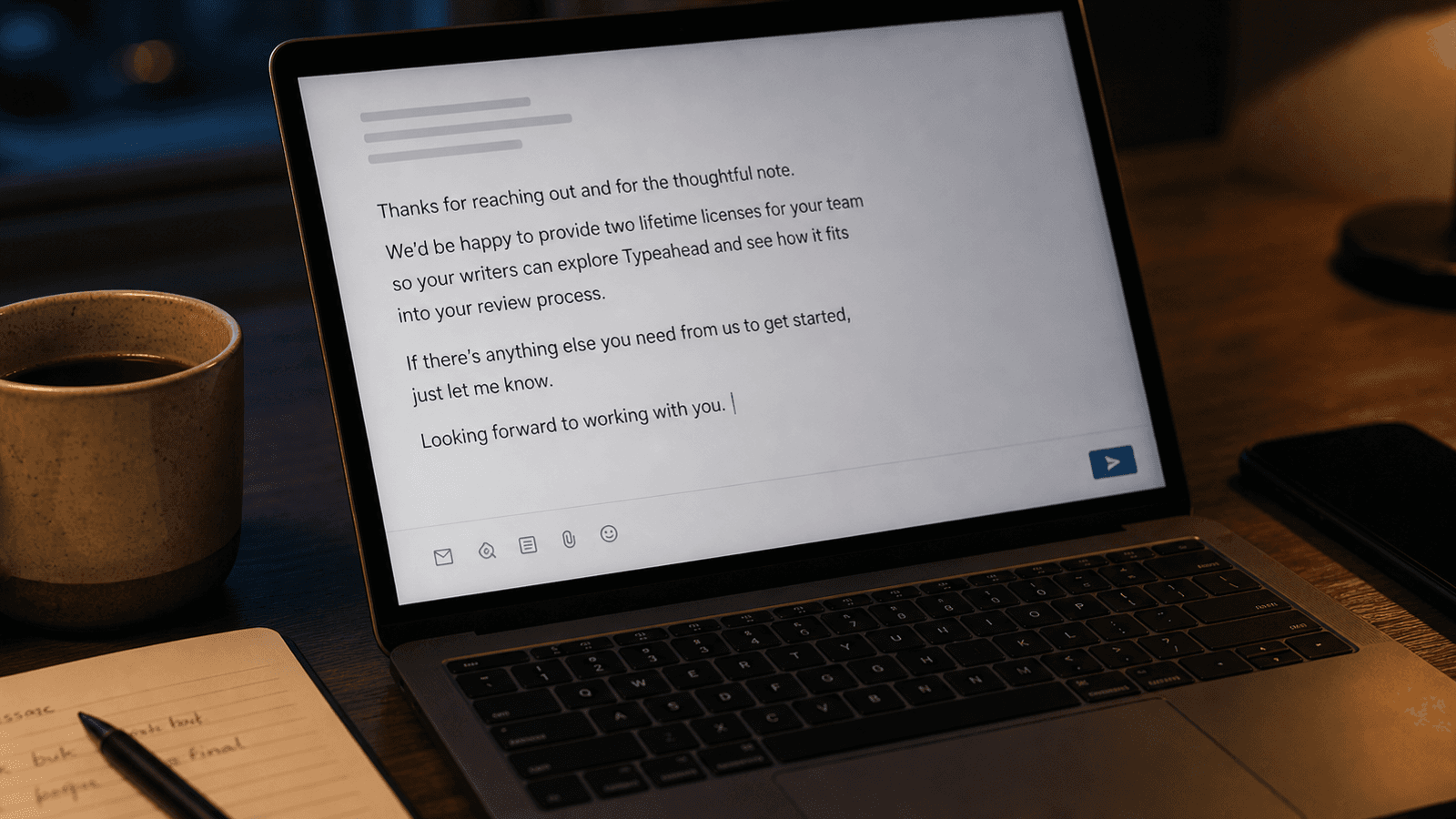
It comes in the minute before you send the message. When the draft is mostly there. When the context is already in your head. When the question is no longer "Can something write this?" but "Is this exactly how I want to say it?"
That is where a lot of writing tools reveal whether they actually help.
Most work writing does not fail at the blank page
Blank-page moments are real. But they are not the center of most working days.
A lot of professional writing is already underway before it feels like "writing."
You are replying in Slack. Finishing an email follow-up. Clarifying a note in a doc. Tightening a comment before a teammate reads it. Softening a sentence in a browser field so it sounds firm but not cold.
By then, the message usually already has direction.
You know what happened. You know what you mean. You know what the other person is waiting for.
The slowdown happens in the last stretch:
- deciding whether the tone is right
- making the ask clear enough to act on
- trimming the sentence that explains too much
- finishing the thought before the moment passes
- getting the wording clean enough to send
That is why the real test for AI writing help is often not generation. It is whether the tool makes that final minute easier without making the message feel less yours.
The minute before send is where judgment lives
This is the part that is easy to underestimate.
The last review before sending can look small from the outside. Sometimes it is only one sentence. Sometimes it is only one word.
But small changes in that moment carry a lot:
- how direct you sound
- how much confidence you project
- whether the message creates urgency or pressure
- whether the reader understands the next step
- whether the note sounds thoughtful or rushed
That is not decorative editing. That is judgment.
And judgment is exactly where a lot of people become skeptical of AI writing tools.
Not because the tools are useless. Because a lot of them show their strength early and create more work late.
The generated draft can look polished. Then the user has to do the real job afterward: reshape the tone, remove the generic phrasing, fix the subtle overstatements, and edit themselves back into the sentence before it goes out.
That is a bad trade if the main thing you needed was confidence at the point of send.
Why full-draft tools often get awkward near the end
Generation-first tools usually assume the hard part is getting words onto the page.
Sometimes that is true. But the minute before send has a different shape.
At that point, you are not looking for a second author. You are looking for a cleaner landing.
That is why full drafts can become clumsy in the final stretch.
They often widen the review surface.
Instead of checking one sentence, you are now checking:
- whether the model changed the meaning
- whether the tone became too smooth
- whether the confidence level became too strong
- whether the writing stopped sounding like you
- whether the result is longer than the moment deserves
The draft may be technically fine. That does not mean it helps.
If the tool makes you supervise a polished paragraph when you only needed help finishing a six-line message, the workflow cost starts to outweigh the convenience. Before you pay for one, three questions for choosing Mac AI help can help you test that workflow cost against the way you actually write.
Good writing help should get lighter as the message gets closer to done
This is where autocomplete has a structural advantage.
When a message is almost ready, the most useful help is usually the least dramatic help.
Not a rewrite. Not a new draft. Not an invitation to leave the app, explain the context, and inspect a block of output.
Just enough support to keep momentum while the writer keeps control.
That might mean:
- completing the next phrase while your intent is still warm
- helping you land the final sentence more cleanly
- reducing the typing drag in a high-attention moment
- making it easier to finish without handing over the message
This matters because the closer a message gets to send, the less people want authorship to move away from them.
They want help inside the sentence, not outside it.
This is especially true across a real workday
The minute-before-send problem does not happen once. It happens all day, across apps.
- Slack replies
- email follow-ups
- doc comments
- project updates
- support messages
- CRM notes
- browser forms
- calendar invites with context attached
That scattered workflow is why chat-style AI can feel heavier in practice than it sounds in theory.
Every time you leave the app, you introduce ceremony. Every time you paste text back in, you create another round of review. Every time the model gives you more than the moment needs, you pay for it with attention.
That is fine for exploration. It is awkward for execution.
The final minute before send is an execution moment.
The best tools reduce hesitation, not responsibility
A lot of writing delay is really hesitation.
Not "I have no idea what to say." More like:
- "This is almost right."
- "I want this to sound calmer."
- "I need this to be clearer before I send it."
- "I know the point, I just want to land it cleanly."
That is a different job than drafting.
The best writing tool in that moment is not the one that takes over. It is the one that helps the writer cross the line from almost-ready to ready.
That keeps responsibility in the right place.
You are still deciding what the sentence means. You are still deciding how firm to be. You are still the one sending it.
The tool is helping with motion, not replacing judgment.
Why this shape fits Typeahead
Typeahead is an AI autocomplete app for Mac that works across the apps where you already write.
It runs locally on your Mac. Suggestions appear inline while you type. You can accept the full suggestion, take it word by word, or ignore it completely.
That makes it a particularly good fit for the minute before send.
Typeahead does not ask you to leave your workflow and supervise a machine-written block of text. It helps at the point where a lot of real writing slows down: inside the sentence, after intent exists, before momentum breaks.
That is useful in Slack. Useful in Mail. Useful in docs, notes, browser fields, and all the smaller places where work writing actually gets finished.
The promise is not that AI will decide what to say for you. It is that the right kind of AI can make the last stretch of writing feel lighter without taking the sentence away from you.
That is the moment people remember.
Not the flashy demo. Not the first draft.
The minute before they send.