







Clinical notes need fewer disclosure paths
4 min read
Clinical documentation cannot be made “without HIPAA risk” by installing one application. It can, however, be designed with fewer places for patient information to go.
The safest disclosure path is the one the note never enters.
Start with the note’s regulatory status
HIPAA does not automatically govern every doctor or every piece of health information. The Security Rule applies to covered entities and their business associates. Covered entities include healthcare providers that conduct specified electronic transactions, while the rule protects PHI maintained in or transmitted by electronic media.
If a clinical note is ePHI, its protection belongs inside the organization’s documented security program. That remains true whether the note sits in a large EHR or on one physician’s Mac.
Map every destination for note text
Before approving writing assistance, trace where the text can travel. Include the application receiving the keystrokes, external processors, logs, temporary files, storage, backups and support access.
HHS says a risk analysis must identify all ePHI and every place it is stored, received, maintained or transmitted. Its guidance expressly includes ePHI on a single workstation.
This mapping is more useful than a vendor badge. HHS does not recognize private Security Rule certifications, and certification does not discharge the organization’s legal duties.
Cloud processing changes the relationship
Sending note text to a cloud service may create a business-associate relationship. According to HHS cloud-computing guidance, a provider that creates, receives, maintains or transmits ePHI is a business associate even if the data is encrypted and the provider lacks the decryption key. An appropriate BAA is required.
HHS draws a practical distinction for software vendors without PHI access. Merely supplying local software does not make a vendor a business associate. Hosting patient information or accessing it during support changes that analysis.
Local completion removes one destination
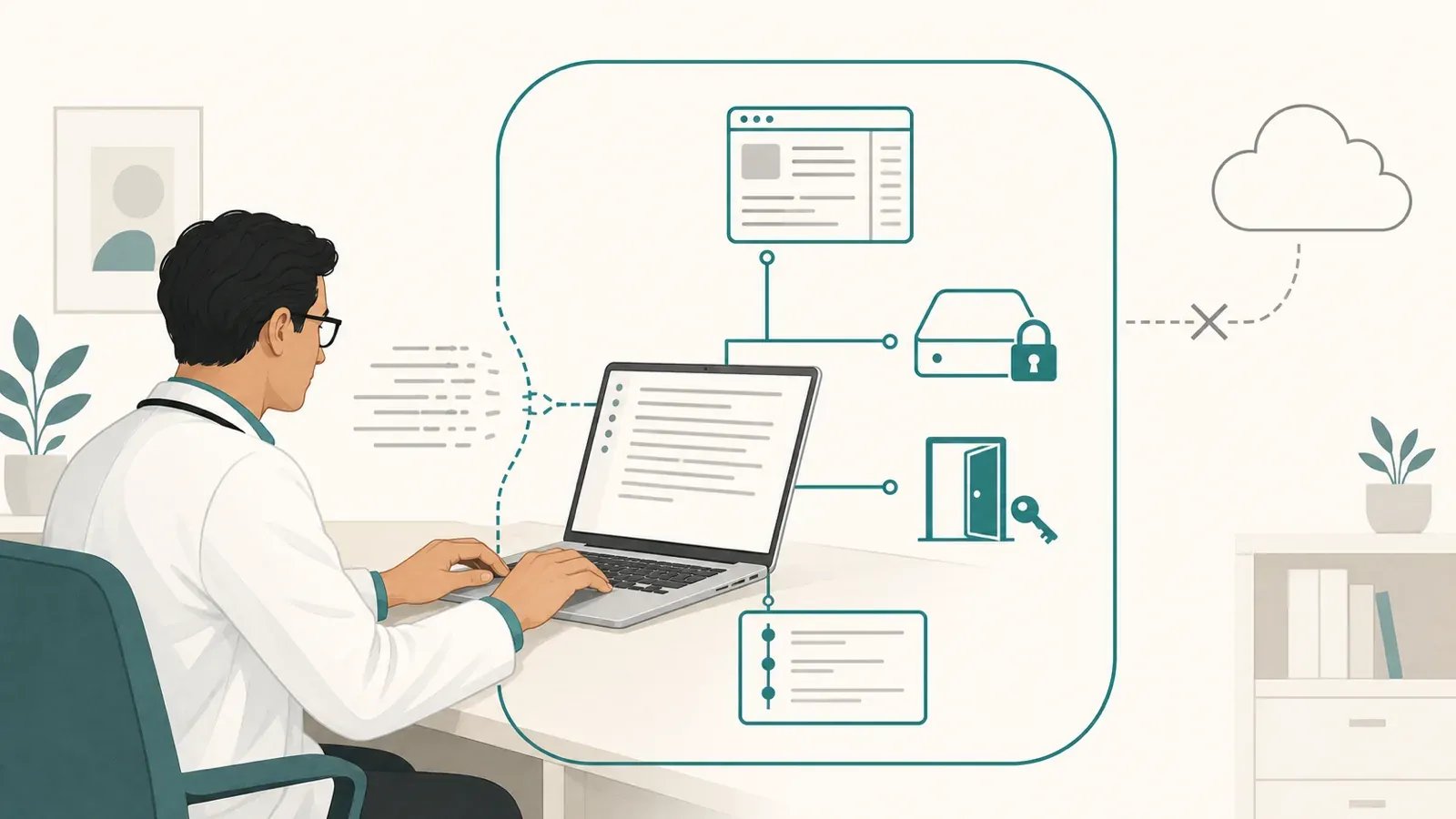
Typeahead processes writing locally; it goes online only to check your license, look for updates and download your AI model, and none of those requests include anything you write. The clinician’s writing never leaves the Mac for sentence completion.
That architecture removes the AI vendor’s server as a destination for note text. The organization should still verify the behavior in its own deployment and record the finding in its risk analysis. Examining what happens when an AI tool reads typing is a useful way to structure that review.
Typeahead is a Mac-only sentence-completion tool for macOS 14 or later. It completes the sentence you are already writing, in your voice. You begin the sentence, it suggests a continuation and you decide whether to accept it.
That distinction matters in medicine. The clinician remains the author rather than handing an encounter to a system that produces a note. Our comparison of AI autocomplete and AI scribes for doctors examines that workflow more closely.
Local does not mean compliant
Local processing removes a disclosure path. It does not secure the Mac, configure the EHR or govern the people around either one.
The organization still needs safeguards for authorized access, audit activity, integrity, authentication, workstation security, devices and incident response. It must also consider local storage, backups, screen visibility, copied text and support procedures. Endpoint controls and the surrounding clinical workflow carry the rest of the protection.
No application can declare that whole environment “HIPAA compliant.” HHS requires an accurate, thorough and ongoing assessment of risks to the confidentiality, integrity and availability of ePHI.
A removed name may reveal a patient
Deleting a patient’s name does not necessarily de-identify a note. Under HIPAA’s Safe Harbor method, listed identifiers must be removed wherever they appear, including free text.
Clinical narratives are information-rich. An unusual diagnosis, distinctive event, location or combination of details may still point back to one person. Treating a narrative as anonymous because its header is clean creates a fragile privacy assumption.
Questions for privacy and security leaders
Before deployment, resolve these points:
- Is the note ePHI in this organization’s context?
- Which applications, files, logs and backups can receive its text?
- Can the vendor access note text during normal use or support?
- Has local processing been verified on the managed configuration?
- Which access, audit, device and incident controls cover the Mac?
- How will updates, model downloads and support be governed?
A local tool can make clinical documentation meaningfully less exposed. The defensible claim is narrow and valuable: note text does not need to visit an AI server for sentence completion. The rest of the workflow still needs the same documented care as every other place ePHI can live.